
Fire Alarm Installation
Understanding Fire Alarm Categories
6 January 2026 • Amrit Derry
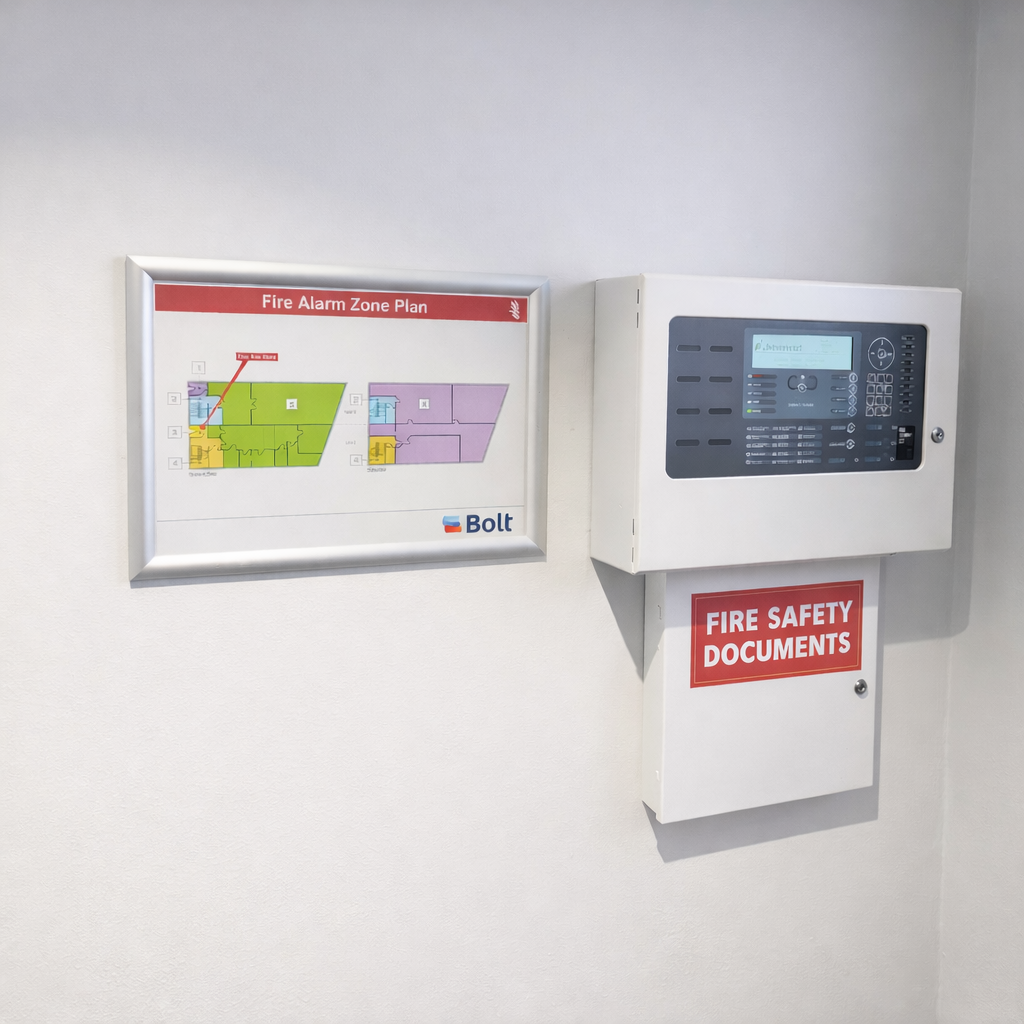
Fire alarm categories define how a system is designed, what it protects and why it is installed. In the UK, these categories are set out in BS 5839-1 codes of practice and apply to non-domestic buildings. Understanding these different classifications will help you specify the correct level of protection your property might need to meet your legal duties.
In this article, we explain the meaning of the main fire alarm categories including L1 to L5, P1 and P2. We explore how each category differs, when they are most commonly used, how each category relates to fire risk assessments and legal responsibilities.
What do fire alarm categories mean?
Fire alarm categories describe the objective and extent of coverage your system provides your property. They do not describe equipment quality or system grade. Instead, they define where detectors are installed and what outcome the system is designed to achieve.
In short, a fire alarm category sets the minimum coverage needed to meet a defined life safety or property protection goal.
This distinction matters because two compliant systems can look very different if their objectives are different. A warehouse and a care home may both be compliant, but under two entirely different categories.
Life protection fire alarm categories (L systems)
Life protection fire alarm categories are the most commonly specified fire alarm classifications in UK commercial buildings. They focus on providing early warning so occupants can escape safely, rather than limiting property damage. For most Responsible Persons, an L category forms the core of their fire alarm compliance.
These categories are labelled L1 to L5 under BS 5839-1, with L1 providing the highest level of coverage. Each step down reduces coverage but may still be appropriate for specific risks.
The correct category for your property will depend on a number of factors including:
- How your building is occupied and used, including normal and out-of-hours activities
- The number of occupants and their familiarity with the building
- Whether occupants are awake, asleep or may require assistance to evacuate
- The layout of the building and complexity of escape routes
- How quickly a fire could develop and affect means of escape
- The presence of higher-risk areas such as kitchens, plant rooms, storage spaces etc.
- The evacuation strategy, including phased or simultaneous evacuation
Each of these factors should be assessed together through a suitable and sufficient fire risk assessment, rather than considered in isolation.
L1 fire alarm system
An L1 fire alarm system is intended to provide the highest level of life protection. Automatic fire detection is installed throughout all areas of the building.
This level of coverage allows a fire to be detected at the earliest possible stage, regardless of its point of origin. The additional warning time is particularly relevant where evacuation may take longer.
L1 systems are typically associated with buildings such as care homes, hotels and large residential premises.
L2 fire alarm system
An L2 fire alarm system is designed to provide additional life protection beyond escape routes alone. Detection is installed on escape routes and within areas identified as higher risk.
The purpose is to give earlier warning from locations where a fire is more likely to start. This can improve evacuation time without extending detection to all spaces.
L2 systems are commonly used in buildings such as industrial settings and premises with identified fire hazards.
L3 fire alarm system
An L3 fire alarm system provides standard life protection and is one of the most frequently specified categories. Detection is installed on escape routes and in rooms opening directly onto those routes.
This arrangement is intended to ensure occupants are warned before fire or smoke affects their means of escape. It balances early warning with proportionate coverage.
L3 systems are widely used in offices, schools and many low to medium-risk commercial buildings.
L4 fire alarm system
An L4 fire alarm system provides a lower level of life protection. Automatic detection is installed only within escape routes.
The system is designed to warn occupants as they make their way towards exits, rather than to detect fire at its source. This limits the available warning time.
L4 systems are generally suitable only for low-risk buildings with simple layouts and short travel distances.
L5 fire alarm system
An L5 fire alarm system is a localised form of life protection. Detection is installed in specific areas to address a defined risk.
Unlike other categories, L5 systems are not based on standard coverage patterns. They rely on a clear justification within the fire risk assessment.
L5 systems are most often used to supplement another category rather than operate as a standalone solution.
Property protection fire alarm categories (P systems)
Property protection category fire alarms are intended to limit fire damage to the property rather than protect its occupants. They focus on early detection to reduce loss, disruption, property damage and financial impact.
These categories are most often installed where business continuity and asset protection are the priority, with these categories helping to meet basic insurer requirements. As with life protection systems, they are defined by BS 5839-1 standards.
While P systems do provide some level of warning to occupants, life safety is not their primary design objective.
P1 fire alarm system
A P1 fire alarm system provides maximum property protection, with automatic detecting covering the entirety of the building.
The objective with these alarms is to detect fire as early as possible to limit damage and prevent any costly downtimes due to loss of stock, equipment damage, reinstatement works or any other interruption to business operations.
P1 fire alarms are common in data centres and similar high-value commercial buildings.
P2 fire alarm system
A P2 system provides minimum property protection. Detection is installed only in high-risk or high-value areas.
This approach limits damage where it matters most, without full coverage for every section of your building. Because of this, P2 fire alarm systems rely on a clear understanding of risk for occupants.
P2 systems are therefore often used where full detection is unnecessary or disproportionate.
Manual life protection fire alarms (LM systems)
In the context of BS 5839-1, LM systems are not a separate category in the same way as L or P systems. Instead, the term is commonly used to describe arrangements that rely solely on manual call points, without any form of automatic fire detection.
These systems depend on occupants discovering a fire and raising the alarm themselves. As a result, warning times are longer and detection is limited to areas that are continuously occupied.
Manual-only systems are generally suitable only for very low-risk buildings with simple layouts and short evacuation distances. Their use must be clearly justified by the fire risk assessment, particularly where changes in occupancy or building use could increase risk.
Where early detection is required to support safe evacuation, an L-category system with automatic detection will normally be more appropriate.
Can life and property protection categories be combined?
Yes, life and property protection categories are often combined within a single system. A common example is an L3/P1 system, where the design addresses both occupant safety and asset protection.
In these cases, the system must fully meet the requirements of each category. The life protection element and the property protection element should each stand on their own, rather than relying on shared coverage.
Any combined category should be directly justified by the fire risk assessment. The need for both life safety and property protection objectives must be clearly identified, rather than assumed as a default approach.
Conclusion
Fire alarm categories define the purpose and coverage of a system, not its quality. Choosing the correct category ensures the level of protection matches building risk and legal responsibility, with any combined categories clearly justified by the fire risk assessment.
If you’re reviewing an existing fire alarm system or are planning changes to your non-domestic property, get in contact with a specialist like Bolt. We’ll discuss your requirements and arrange a site survey to determine how to proceed with getting your property compliant with BS 5839-1 regulations.